
All Range Electrolytic Capacitor

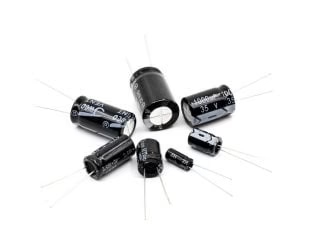
Electrolytic Capacitor: A Deep Dive into Structure, Working, Types, Applications & Selection Guide
Table of Contents
- Introduction to Electrolytic Capacitors
- How Electrolytic Capacitors Work
- Types of Electrolytic Capacitors
- Construction & Materials Used
- Key Electrical Properties & Parameters
- Applications in Electronics & Power Systems
- Advantages & Disadvantages
- Selection Guide: Choosing the Right Capacitor
- Testing & Troubleshooting
- Future Trends & Innovations in Capacitor Technology
- Conclusion
1. Introduction to Electrolytic Capacitors
What is an Electrolytic Capacitor?
An electrolytic capacitor is a polarized capacitor with high capacitance values, typically ranging from 1 µF to several thousand µF. It is widely used in power supplies, signal filtering, and electronic circuits.
Why Are Electrolytic Capacitors Important?
? High capacitance in a small package
? Ideal for filtering and energy storage
? Essential for voltage regulation and power supply circuits
2. How Electrolytic Capacitors Work
Electrolytic capacitors store and release electrical energy using a thin dielectric oxide layer and an electrolyte. The working principle follows:
- Charging: When voltage is applied, electrons accumulate on one plate, creating an electric field.
- Dielectric Action: The oxide layer acts as an insulator, allowing charge storage.
- Discharging: When connected to a load, the capacitor releases stored energy.
Capacitance Formula
C=?r?0AdC = \frac{\varepsilon_r \varepsilon_0 A}{d}C=d?r??0?A?
where:
- CCC = Capacitance (Farads)
- ?r\varepsilon_r?r? = Relative permittivity of the dielectric
- ?0\varepsilon_0?0? = Permittivity of free space
- AAA = Plate area
- ddd = Dielectric thickness
3. Types of Electrolytic Capacitors
Electrolytic capacitors are classified based on their electrolyte and construction:
1. Aluminum Electrolytic Capacitors
- Most common type
- Uses aluminum oxide dielectric
- Used in power supply filtering, DC circuits
2. Tantalum Electrolytic Capacitors
- Uses tantalum pentoxide dielectric
- More stable & reliable than aluminum capacitors
- Used in high-precision circuits, medical devices, and aerospace
3. Polymer Electrolytic Capacitors
- Uses solid conductive polymer instead of liquid electrolyte
- Low ESR (Equivalent Series Resistance), ideal for high-frequency applications
- Found in high-performance computers, telecom, and automotive applications
4. Hybrid Electrolytic Capacitors
- Combination of liquid & polymer electrolytes
- Higher endurance & temperature stability
4. Construction & Materials Used
Main Components of an Electrolytic Capacitor:
? Anode Foil: Made of etched aluminum or tantalum, increases surface area.
? Dielectric Layer: Oxide film on anode, very thin for high capacitance.
? Electrolyte: Liquid, gel, or solid material, provides conductivity.
? Cathode Foil: Serves as the second terminal, helps in charge flow.
? Encapsulation: Aluminum casing or epoxy resin for mechanical protection.
5. Key Electrical Properties & Parameters
1. Capacitance Value
Indicates the capacitor’s ability to store charge, measured in microfarads (µF).
2. Voltage Rating (WVDC – Working Voltage DC)
The maximum DC voltage the capacitor can handle without breaking down.
3. ESR (Equivalent Series Resistance)
Lower ESR = Better performance in high-frequency applications.
4. Leakage Current
Small amount of current that flows through the dielectric over time.
5. Ripple Current Handling
Ability to handle AC ripple currents without overheating.
6. Temperature Range & Stability
Higher temperature ratings lead to better reliability & longer lifespan.
6. Applications of Electrolytic Capacitors
1. Power Supply Filtering
? Used in SMPS (Switched-Mode Power Supplies)
? Smoothens DC output voltage
2. Energy Storage & Backup
? Used in DC-link circuits of inverters
? Stores charge for quick energy discharge
3. Signal Coupling & Decoupling
? Blocks DC while allowing AC signals to pass
4. Motor Starters & Industrial Use
? Used in AC motor start/run circuits
? Helps in voltage stabilization
7. Advantages & Disadvantages
? Advantages
? High capacitance-to-volume ratio
? Cost-effective & widely available
? Works well for power filtering
? Disadvantages
? Polarity-sensitive (incorrect polarity = damage)
? Limited lifespan & aging issues
? Temperature-sensitive leakage current
8. Selection Guide: Choosing the Right Capacitor
Factors to Consider:
? Capacitance value & voltage rating
? ESR requirements (Lower ESR = Better performance)
? Operating temperature range
? Expected lifespan & reliability
9. Testing & Troubleshooting Electrolytic Capacitors
1. How to Test an Electrolytic Capacitor?
? Multimeter Test – Check capacitance & resistance
? ESR Meter – Measure Equivalent Series Resistance
? Leakage Current Test – Detect insulation failure
2. Common Failure Modes
? Electrolyte Drying – Leads to reduced capacitance
? Overvoltage Damage – Causes dielectric breakdown
? Bulging or Leaking – Sign of internal failure
10. Future Trends & Innovations in Electrolytic Capacitors
? Development of solid-state polymer capacitors
? Enhanced high-temperature tolerance designs
? Miniaturization & high-frequency performance improvements
11. Conclusion
Electrolytic capacitors play a crucial role in modern electronics. Whether in power supplies, industrial applications, or communication systems, their high capacitance and efficient energy storage make them indispensable.
? Selecting the right capacitor ensures reliability, longevity, and efficiency in any electronic application.
General Questions About Electrolytic Capacitors
1. What is an Electrolytic Capacitor?
An electrolytic capacitor is a type of polarized capacitor that uses an electrolyte to achieve a high capacitance value. It is widely used in power supplies, signal filtering, and DC circuits.
2. What Are Electrolytic Capacitors Used For?
Electrolytic capacitors are commonly used in:
? Power supply filtering (reducing ripple voltage)
? Energy storage and release
? DC blocking and AC coupling
? Signal smoothing in audio and RF circuits
? Voltage stabilization in motor drives and inverters
3. How Do Electrolytic Capacitors Work?
Electrolytic capacitors store electrical energy by accumulating charge on two conductive plates separated by an oxide dielectric layer. The electrolyte enhances conductivity, allowing high capacitance values.
4. What Are the Main Types of Electrolytic Capacitors?
? Aluminum Electrolytic Capacitors – Most common, used in power supplies.
? Tantalum Electrolytic Capacitors – More stable, used in precision circuits.
? Polymer Electrolytic Capacitors – Lower ESR, ideal for high-frequency applications.
? Hybrid Electrolytic Capacitors – Combination of liquid and polymer electrolytes.
5. Why Are Electrolytic Capacitors Polarized?
Electrolytic capacitors are polarized because their dielectric layer (oxide film) is formed only in one direction. Reversing polarity can destroy the capacitor by causing a short circuit or explosion.
6. How Do You Identify the Positive and Negative Terminals?
? Positive terminal (+): Longer lead, marked with a + sign.
? Negative terminal (-): Shorter lead, marked with a stripe on the casing.
7. What Happens if You Reverse the Polarity of an Electrolytic Capacitor?
? Reversing polarity can cause:
? Excessive leakage current
? Dielectric breakdown
? Overheating and explosion
8. What Is the Lifespan of an Electrolytic Capacitor?
The lifespan depends on temperature, voltage, and ripple current. A typical capacitor lasts 1,000 to 10,000 hours at its rated temperature but can degrade faster under stress conditions.
9. What Is ESR (Equivalent Series Resistance) in Electrolytic Capacitors?
ESR represents the internal resistance of a capacitor.
? Low ESR = Better performance in high-frequency applications
? High ESR = More heat generation, lower efficiency
10. How Do You Test an Electrolytic Capacitor?
? Multimeter: Measures capacitance and resistance.
? ESR Meter: Checks for internal resistance issues.
? Leakage Current Test: Determines insulation breakdown.